


The
Heir apparent to the great J.M.W. Turner
The Art Journal, 1860.
In
1857, Church was 31 years old, at the height of his powers, eclipsing
all others as,
The Michaelangelo of Landscape Painting.
|
'Many mid-
nineteenth century Americans would have found a particular relevance
in any work of art that made reference to the Garden of Eden,
for the New World was, of course widely regarded by its proud
citizens as a second Eden.' Dr. F. Kelly p.p. 31 & 32: Frederic
Edwin Church and the National Landscape. N.B. Go to,
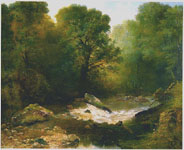
the middle-right of Rocky Forest Pool 1857 and you
will notice that there is a 'region' of Light - reflected off
the light green trees in the luminous evanescent distance,
representing, God and, Paradise Regained. |
|
'Church's interest in English art was shown in another way. In 1852, he sent one of his works The Natural Bridge, Virginia '52 to the annual summer exhibition of the Royal Academy in London. The
Natural Bridge, Virginia '52 - in
size, color and technique- is most like Rocky Forest Pool '57. Church has painted the trees and the sky under the bridge in the same way, including the sweep of branches and the feathering of the leaves to the branches on the left and right foreground. It would be interesting to know how Rocky Forest Pool '57 came to England. Was it as a result of this exhibition? By 1852 Church 'seems to have been receiving numerous commissions' that 'probably went directly from Church's studio to their owners.' Dr. F. Kelly, p. 148, footnote 32: Frederic Edwin Church and the National Lanscape. |
|
Ibid. p.112.
Re: Heart of the Andes 1859. The flow of water and
the background scumbling and color of trees in both are similar. |














|


