
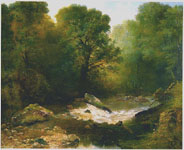


'Nothing
is accidental;
he has meditated his thought, breathed his inspiration,
lived
in the spirit of his subject, so that every stroke of his pencil is guided
by
the unerring instinct of faith in that which he beholds.'
Russell's Magazine, 5th August 1859.
|
Ibid., p.
109-111. In Twilight in the Wilderness 1860 to the
middle-left foreground 'at the top of the stump (almost in silhouette
against the river) Church carefully delineated several jagged
splinters of wood, two of which are arranged to form an |
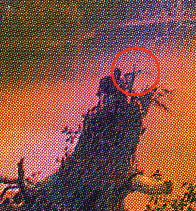 unmistakable
(small) Cross.'
unmistakable
(small) Cross.' 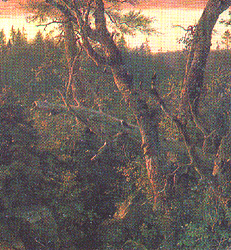 leaning dead tree with crossed intersecting branches forming an
oval against the sky similar to the oval in the heart of the ghostly
Main Oak in Rocky Forest Pool
- which is also leaning and soon to die. 'Its branches trace writhing
patterns against the sky.' Ibid., p.115. In Rocky Forest
Pool they seem to have some hieroglyphic
significance? Are they Church's or The Charter Oak's initials?
In the
right hand foreground corner of Rocky Forest Pool '57
there is a similar shaped amorphous oval to the one in the ghostly
Main Oak. These are set along the diagonal line which points
to the brightest part of the sky - to the Divine Light
on High and which mystically, Lights the Water. Please go
back to: Explore The Painting, for a visual demonstration.
leaning dead tree with crossed intersecting branches forming an
oval against the sky similar to the oval in the heart of the ghostly
Main Oak in Rocky Forest Pool
- which is also leaning and soon to die. 'Its branches trace writhing
patterns against the sky.' Ibid., p.115. In Rocky Forest
Pool they seem to have some hieroglyphic
significance? Are they Church's or The Charter Oak's initials?
In the
right hand foreground corner of Rocky Forest Pool '57
there is a similar shaped amorphous oval to the one in the ghostly
Main Oak. These are set along the diagonal line which points
to the brightest part of the sky - to the Divine Light
on High and which mystically, Lights the Water. Please go
back to: Explore The Painting, for a visual demonstration.| In New
England Scenery 1851,* Church altered the oak next to its
companion elm from his preparatory sketch where it is upright to
here, where it is leaning dangerously to the right. Transactions
of the Art Union 1844, P.p. 7,15. When he painted New England Scenery 1851 Church was aware that the Charter Oak had caught fire in 1849 and perhaps sensed that this important historical tree would not have long to live? * To view go to: References |
| Dr. F. Kelly, p.p. 72. 73: Frederic Edwin Church and the National Landscape. |














|


