|
Preparatory
sketches (page
1 of 2)
In
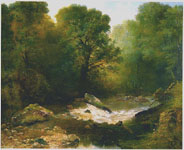
the New England Woods 1855-1865
Dimensions: Museum Notes, H: OM173 x W: OM305
COOPER-HEWITT MUSEUM. REF: DP 1917- 4 - 664A
Humboldt believed that the use of 'coloured sketches taken
on the spot' were necessary. Church agreed and followed his
dictum in this oil sketch which - if studied carefully
reveals 15 similar features with Rocky
Forest Pool 1857.
In
the New England Woods 1855-1865 also seems to
be the actual location of Rocky
Forest Pool 1857 (and if it is, the attributed
dates will need to be changed to 1855-1856).
With
all the other evidence - that would place it within
a 40 x 10 mile region (running North/South) of the Green Mountain
Forest in Vermont, Northern New England and starting from
Cuttingsville and Clarendon in the middle.
The similar naturally fallen tree or branch
of In
the New England Woods 1855-1865 is reflected in
the pool of water in the foreground. Instead of one end of
the tree being in the water (as in the finished painting)
it is pointing towards the Light on the Water
as it also does in Rocky
Forest Pool 1857.
Here, this 'crystal lake' or pool also reflects
the sky and the Divine Light from on High. Where the
Rock in the sketch is white with Light (using
impasto) Rocky
Forest Pool 1857 has the running water in the
brook, white with Light (using impasto). The metaphor
is changed in Rocky
Forest Pool 1857 for the Way of
Christ although the Rock remains partially
lit from the same Divine Light source
as the water - from 'on High' in both works.
In Rocky
Forest Pool 1857 the fallen tree is now pointing
as it does later in Twilight in the Wilderness 1860
with a similar Christian lesson. With In
the New England Woods 1855-1865 the main
tree supporting the pointing branch is described in
the museum notes as 'a maple (?).' This pointing branch
also points to a large Rock similar
in size, shape and position to the Rock behind
the pointing tree in Rocky
Forest Pool 1857. This maple and its canopy of
leaves are at the same angle and position and
planted on a similar sized bank as the maple
next to the fallen pointing tree in Rocky
Forest Pool 1857
His colours in the sketch are the same as in
his finished painting with the same shaft of
blinding white Light illuminating the heart of the
sketch - as in the main picture - thereby imparting its main
'lesson.' This shaft of Light is alo used by Church
in his oil sketch
A
stream in the New England Mountains (Archive
of American Art DP1917- 4 - 861). Like
Durand's In the Woods 1855. which inspired him,
Church starts with a vertical sketch of a scene visited.
In
the New England Woods 1855-1865 also shows
the same brook flowing the same way towards the same hallowed
Rock and a similar clump of trees to the
Trinity of Trees in Rocky
Forest Pool 1857
The
viewer also hovers, suspended above the brook in both
and similarly, it also leads
you into the picture with the flow and direction of the water
- towards the Divine (and away from yourself and human
frailty?)
In
this oil sketch, Church also introduces the same
light-green pointïllistic feathering to paint the leaves which
are catching the light particularly on the same (almost
identical) sweeping branches to the middle-left in both paintings.
This brushwork is technically like (and derived) from the
trees in
The
Natural Bridge Virginia 1852
The background scumbling of trees is treated similarly
in all of these oils including, View of Cotopaxi
1857. See similar scumbling work in, Distant
View of Sangay Volcano, Ecuador 1857.
End
of page 1. (of 2) To go to page 2 of Preparatory sketches
Click on Next button below.
|