


Church
was the
Paradigm of the artist who becomes the public voice
of a culture,
summerising its beliefs, embodying its ideas and confirming its assumptions.
Nature and Culture, Barbara Novak
|
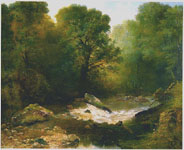
'Nothing is accidental; he has meditated his thought, breathed his inspiration, lived in the spirit of his subject, so that every stroke of his pencil is guided by the unerring instinct of faith in that which he beholds.' Russell's Magazine 5th August 1859. There are three representations of The Trinity within Rocky Forest Pool '57. A trilogy or Trinity of Trinities. To activate the inter-active analysis of the Christian symbolism and find the Trinity of Trinities, please go to: Explore the Painting. |
|
This small
oil sketch was originally known and sold as Sunset
by Sotheby's Parke Burnet in 1978. According
to The Cosmopolitan Art Journal "this exquisite picture
representing the setting of a single star upon a placid lake"
was painted as a memorial to a recently deceased child of Erastus
Dow Palmer who had been named after Church. |
|
'More immediate was the growing threat of civil strife between the North and the South over the question of whether slavery should be extended into the newly acquired western territories.' Tim Barringer, American Sublime Catalogue, p.130. Assistant Professor in the History of Art, Yale University. Twilight in the Wilderness 1860 is an epic painting which also resonates with Christian meaning and is the technical pinnacle of his American wilderness paintings. "Solitude reigns over the scene and as the eye ever turns away from the wilderness below to gaze upon the brilliant canopy of the sky, the imagination whispers that He who was once 'led up of the spirit into the wilderness to be tempted' must often at the twilight hour have turned His gaze from the gloom and loneliness of the forest to the brightness and beauty of those heavens to which His vision of faith were ever opened, revealing the 'Father of Lights.' Art Matters in Baltimore, Boston Evening Transcript, 4th March 1861' from Dr. Gerald L.Carr 1980, p.16. |
|
In 1855 when Durand painted In the Woods to widespread acclaim, Church was aware of Durand's reputation as the most influential painter of the day and had previously been inspired to follow his lead in his attempts to challenge him. Durand's An Old Man's Reminiscences 1845* influenced Mt Ktaadn 1853. His unlocated Shipwreck, Clearing up after a Storm probably inspired Church to the theme of the wreck in his mediocre painting The Wreck 1852*, etc,. Andreas Achenbach's stormy seascape Clearing up, Coast of Sicily '47* was eclipsed by Church in Coast Scene, Mount Desert 1863.* Equally, Durand's
In the Woods 1855 was quite probably the inspiration
for Rocky Forest Pool '57 (in which Church surpasses
Durand - technically, imaginatively, spiritually and intellectually). |
| 'From this point on, Church and Winthrop became thoroughly immersed in the wilderness experience and began a "new life" sanctified by a "baptism" in the Penobscot River. Theodore Winthrop, p.67: Life in the Open Air and Dr. F. Kelly, p.89: Frederic Edwin Church and the National Landscape. |
|
'Mr. Church has condensed the condensation of nature' said Theodore Winthrop in A Companion to The Heart of the Andes 1859. Church had already started condensing nature in 1855 when he painted The Andes of Ecuador. He continued with Rocky Forest Pool '57 and then with all his major work. 'The concentration of reality and the shorthand of sensation' was the famous 20th Century painter, Francis Bacon's definition of good Art. Paul Klee's
definition was; 'Art is not there just to reproduce
the visible, but to render visible what lies hidden behind the
visual world.' Church was, is, and will remain, the eternal genius. |
|
|













|

 (meaning God's Gift) or Theodore in English.
