|
Modus
Operandi or Working Method
Thomas Cole - like Alexander Von Humboldt - taught Church,
along these lines: 'The most lovely and perfect parts of nature
may be brought together and combined in a whole that shall
surpass in beauty and effect any picture painted from a single
view….he who would paint compositions and not be false must
sit down amidst his sketches, make selections and combine
them and so have nature for every object he paints' 
As
with most of his Studio paintings, Church worked out the rough
composition, colour and detail in his many pencil sketches
and oil studies in the field, which he would execute, impromptu,
on his travels. He would then often change details in
his final work but these idealised studio landscapes
should generally be enjoyed more for their beauty and accuracy
in painting nature and natural phenomena than for the accuracy
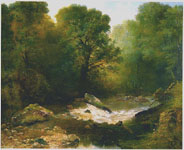
of an actual scene. As with Rocky
Forest Pool '57 they often have deeper spiritual resonance
for those who choose to learn 'the lessons' from deciphering
them. The
Natural Bridge, Virginia 1852 and Niagara
1857 depict real places but most of his landscape
paintings were only loosely based on his many pencil and oil
sketches.
Find the spot where he painted, In
the New England Woods 1855-1865, and we believe
that you will have found the location of Rocky
Forest Pool '57. With
all the other evidence - that would place it within
a 40 x 10 mile region (running North/South) of the Green Mountain
Forest in Vermont, Northern New England and starting from
Cuttingsville and Clarendon in the middle
Like
a diary, Church referred to these sketches and notes continually.
There are only 8 years between Freeman
Brook (?) near Cuttingsville, Vt. August 1849 and
Rocky
Forest Pool '57, yet they share the same scene
and at least 8 similar features
'Relying
solely on his own pencil drawing of October 1856'
Church painted Niagara
from the American Side in 1867 - 11 years earlier.
Prof Tim Barringer, Yale.
Church
was not always that good an artist. Even Picasso admitted,
'I sometimes paint a fake Picasso' when he was unhappy with
his work. With, Tequandama
Falls '54, he was advised, that 'he should not
paint falling water - 'for he cannot' by the "Editor's Table,"
The Knickerbocker 45, May1855, p.532. They also considered
The
Wreck 1852 'much inferior '
to, Home
by the Lake 1852.
Church
learnt prolifically and fast. Just look at the progress that
he made in one year between 1854 when he painted the unconvincing
waterfall in Tequandama
Falls and 1855, when he painted, The Andes
of Ecuador. Then look at the water now 'perfectly
represented' in Rocky
Forest Pool '57 and Niagara
1857.
'When
he wished to, he could cover large areas of canvas speedily.'
Morning
in the Tropics 1858, Oosisoak 1861
and Under
Niagara 1862, he painted, 'each within a day's
time or less. Further, he consciously adjusted his paint handling
from picture to picture and from one chronological period
to another' Dr. Gerald L. Carr. Church even claimed
in a letter to Erastus Dow Palmer, Sept 1888 that the mighty
Niagara
1857 had been completed in two months.
With,
Rocky
Forest Pool '57, Church is at his peak where -
'he appeals to our love of the wild and free, where he leads
us to a glade in the wilderness, where we see no sound that
reminds us of civilisation or humanity' and where we can
find our peace with God.
|