The essay
Composition and metaphor
Follow the balance between woods, water and light, and the study’s reading of the woodland as a place of contemplation.
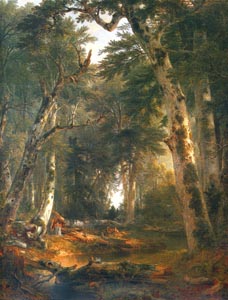
The compositional balance in Rocky Forest Pool 1857 between the Trilogy of the Woods the Water and the Light is more even (than Durand's In the Woods). If the metaphor of the Woodland Cathedral is less obvious, it is more subtle and less threatening - more mystical.
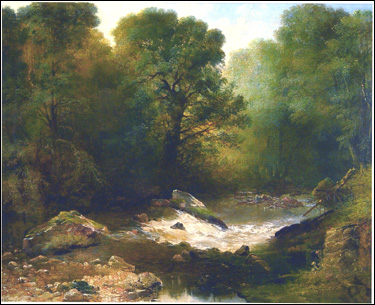
Not so much a Cathedral, more a Way. [1]
There is more light - The Light on the Water and no need to climb over the fallen logs of Durand's In the Woods 1855.
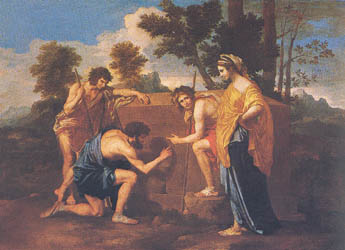
Rocky Forest Pool 1857 reflects less ominously the spirituality of Nature and more the lightness and beauty of it in contemplating 'et in Arcadia ego' - 'and I too lived in Arcadia.' This inscription, on the tombstone of Poussin's painting The Arcadian Shepherds- circa.1655 - was also a reminder of their own mortality and the need to follow the Christian Way. [2]
'A realm where sunshine never scorches and yet shade is sweet,' was how Church's travelling companion Theodore Winthrop described it when they travelled through New England and Maine in the summer of 1856. [3]
Title
asterisk *The
Andes Of Ecuador 1855
Footnote
asterisk * Heart
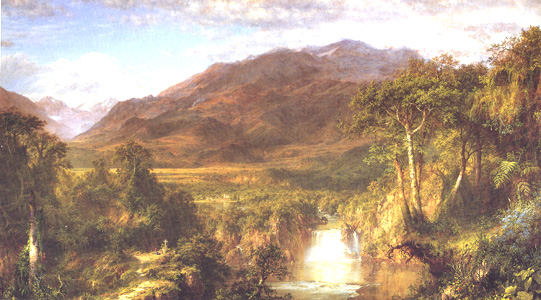
of the Andes 1859
Additional context from the original page
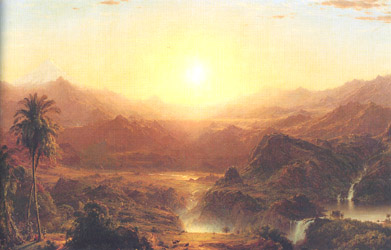
The Light on the Water. Rocky Forest Pool has a powerful Christian message like the Andes of Ecuador 1855* which, Dr. Gerald Carr describes as, A sweeping Christianised Panorama.
Notes and sources
Note 1
Dr. Gerald L. Carr describes The Andes of Ecuador 1855 as 'a sweeping christianized panorama' and within it, Dr. David Huntington shows us the 'Golden Cross of Light.'
Rocky Forest Pool '57 has an equally powerful Christian message. There are three representations of The Trinity within Rocky Forest Pool '57. A Trinity or (trilogy) of Trinities. This is typical of Church's sense of humor; he loved visual puns, symbols and codes.
To decode Rocky Forest Pool's main 'lesson' and in order to find God, you have to follow the Way of the Cross and the Light on the Water - in other words, Christ - which flows towards the Trinity of Trees in the luminous evanescent distance.
Christ, 'withdrew into the wilderness and prayed.' The Gospel according to St Luke, Chapter 5, 16. Church did the same in 1856 with Theodore Winthrop.
Rocky Forest Pool is the creative result. It is a prayer, a poem and a lesson. 'Winthrop's record of his visit to New England and Maine with Church, recounted in his book Life in the Open Air is the key to understanding Church's North American landscapes of the later 50's'. Dr. F. Kelly.
Theodore Winthrop divided and analyzed The Heart of the Andes 1859 * into 10 different 'regions' and invited viewers to look at them through a viewing tube. Inspired by this approach to 'viewing many pictures in one' we invite you to use the inter-active analysis of the Christian symbolism in Rocky Forest Pool '57 and find the Trinity of Trinities. To do this, please go back to: Explore the Painting.
Note 2
Nicholas
Poussin 1594-1665 & Claude Lorraine
(Gellée) 1600-1682. Two very influential French painters who
went to live in Rome.
One of
the greatest academic masters, Poussin studied
the classical world of myth, architecture and statuary for
inspiration in depicting, the antique world of order, innocence
and dignity.
Et in Arcadia ego (Even in Arcady, I am), depicts
two young shepherds looking at the inscription on a tomb in
a wooded landscape, while a third one points at the inscription
and seeks askance from a beautiful but melancholic shepherdess
who is gazing down, distractedly. The meaning is that I, (Death)
reign even here, in Arcady, and a reminder of their own mortality.
It was Claude Lorraine who painted the first realistic and sublime depictions of nature in his classically composed landscapes suffused with light. He was a big influence on Cole and on Church's formulaïc early work.
The Andes of Ecuador 1855 * proved that Church had a burning ambition and a truly original Genius to go beyond the past.
Note 3
In 1856 'they pushed across to Vermont and into New Hampshire.' Here, it refers to 'the valley of upper Connecticut.' Dr. F. Kelly p.p. 88 & 89: Frederic Edwin Church and the National Landscape.
'We became Arcadians. Such is Arcadia, if I have read aright: a realm where sunshine never scorches, and yet shade is sweet.' Theodore Winthrop in his travelogue Life in the Open Air, p.7.
But
there are other forces at work.
Go to the middle-right of the painting and you will notice
that there is an area of Light - reflected off the light green
trees in the luminous evanescent distance representing,
God and Paradise Regained.
Now
look at the dark area to the middle-left (on the left-hand
side of the ghostly main oak) to find - a 'region' of indescribable
darkness representing, Satan and Paradise Lost.
`
'And the Light shineth in Darkness; and the Darkness comprehended
it not' The Gospel according to St John. Chapter I, Verse
V (5).
From the original Rocky Forest Pool study, © Oliver Thiebaud, 1985, 1995, 2002. Wording retained for review; interpretations and citations have not been independently verified.