The essay
Symbolism and language
The study connects the oak, elm and crossed branches with Church’s religious beliefs and the symbolism of the American landscape.
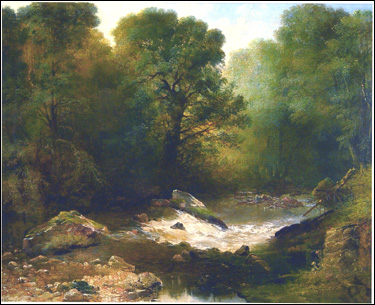
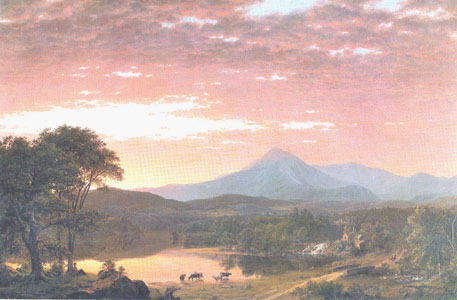
To the middle right of Rocky Forest Pool 1857 is the naturally fallen tree with its clear Cross of intersecting branches - which he was to use again in, Twilight in the Wilderness 1860 [1] Here it is pointing in to the Light on the Water and beyond to the fading somewhat ghostly Main Oak on the other side. It is a strange place - so near to the brook - for a large leaning dark oak partly in silhouette. Is it beginning to fall and a reminder of the Charter Oak ('the aged tree was toppled by a windstorm on August 21st 1856') yet with its roots still in the River of Life? Christ's Charter is of course, The New Testament and the Charter Oak was the famous hiding place for Hooker's Charter which was the important civil, legal and religious declaration or Testament, for Connecticut.
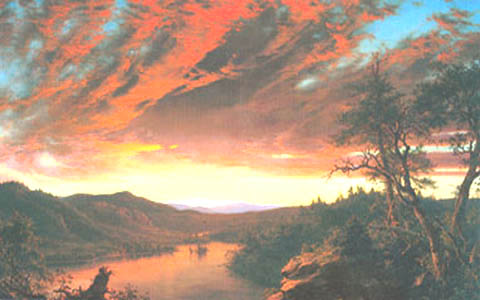
Once again Church depicts 'the instructive events of our history especially those of moral grandeur and heroism.' [2] Hartford City gave the Charter Oak a public funeral 'worthy of the fallen hero' and afterwards, Church who was most upset at its demise avidly collected fragments of the dead tree, like the holy relics of a patron Saint ('I went to Hartford and secured portions of the wood'). Today, at Church's home 'Olana' there are two partial cross sections one of a branch and the other of a root and a letter opener all inscribed, 'Charter Oak.'
He also referred to the symbolism of Oak and Elm, in his (similar sized) painting of The Charter Oak 1847 (& also The Charter Oak at Hartford 1846-47). Church had shown the historical origins of Hartford, with a young vigorous but smaller elm growing next to the oak, that represented the future for his home town.
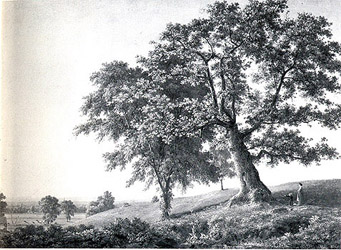
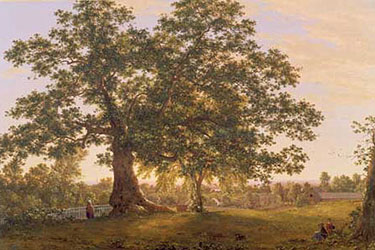
The Oak was linked symbolically as well with the Old World (and England in particular) because of its associations with history but the elm, was specifically associated with the New World. In Mount Ktaadn 1853 the prominent pairing of an oak and an elm should be seen as symbolic because, neither oak nor elm grew in the Katahdin region. [3]
Additional context from the original page
'Nothing is accidental; he has meditated his thought, breathed his inspiration, lived in the spirit of his subject, so that every stroke of his pencil is guided by the unerring instinct of faith in that which he beholds.' Russell's Magazine, 5th August 1859.
Notes and sources
Note 1
Ibid., p.
109-111. In Twilight in the Wilderness 1860 to the
middle-left foreground 'at the top of the stump (almost in silhouette
against the river) Church carefully delineated several jagged
splinters of wood, two of which are arranged to form an 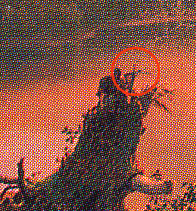 unmistakable
(small) Cross.'
unmistakable
(small) Cross.'
To the
right is the naturally fallen pointing tree which
projects and prescribes an arc towards this Cross and in
the same direction as the main living creature, and the symbol
of North America - the Bald Eagle.
In front of the naturally fallen pointing tree is
a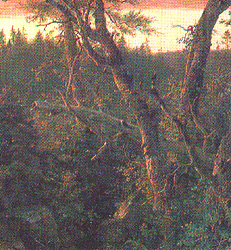 leaning dead tree with crossed intersecting branches forming an
oval against the sky similar to the oval in the heart of the ghostly
Main Oak in Rocky Forest Pool
- which is also leaning and soon to die. 'Its branches trace writhing
patterns against the sky.' Ibid., p.115. In Rocky Forest
Pool they seem to have some hieroglyphic
significance? Are they Church's or The Charter Oak's initials?
In the
right hand foreground corner of Rocky Forest Pool '57
there is a similar shaped amorphous oval to the one in the ghostly
Main Oak. These are set along the diagonal line which points
to the brightest part of the sky - to the Divine Light
on High and which mystically, Lights the Water. Please go
back to: Explore The Painting, for a visual demonstration.
leaning dead tree with crossed intersecting branches forming an
oval against the sky similar to the oval in the heart of the ghostly
Main Oak in Rocky Forest Pool
- which is also leaning and soon to die. 'Its branches trace writhing
patterns against the sky.' Ibid., p.115. In Rocky Forest
Pool they seem to have some hieroglyphic
significance? Are they Church's or The Charter Oak's initials?
In the
right hand foreground corner of Rocky Forest Pool '57
there is a similar shaped amorphous oval to the one in the ghostly
Main Oak. These are set along the diagonal line which points
to the brightest part of the sky - to the Divine Light
on High and which mystically, Lights the Water. Please go
back to: Explore The Painting, for a visual demonstration.
Note 2
When he painted New England Scenery 1851 Church was aware that the Charter Oak had caught fire in 1849 and perhaps sensed that this important historical tree would not have long to live?
* To view go to: References
Note 3
From the original Rocky Forest Pool study, © Oliver Thiebaud, 1985, 1995, 2002. Wording retained for review; interpretations and citations have not been independently verified.