Freeman Brook
Explore the study’s proposed connections between the graphite sketch near Cuttingsville and the composition of Rocky Forest Pool.
Freeman
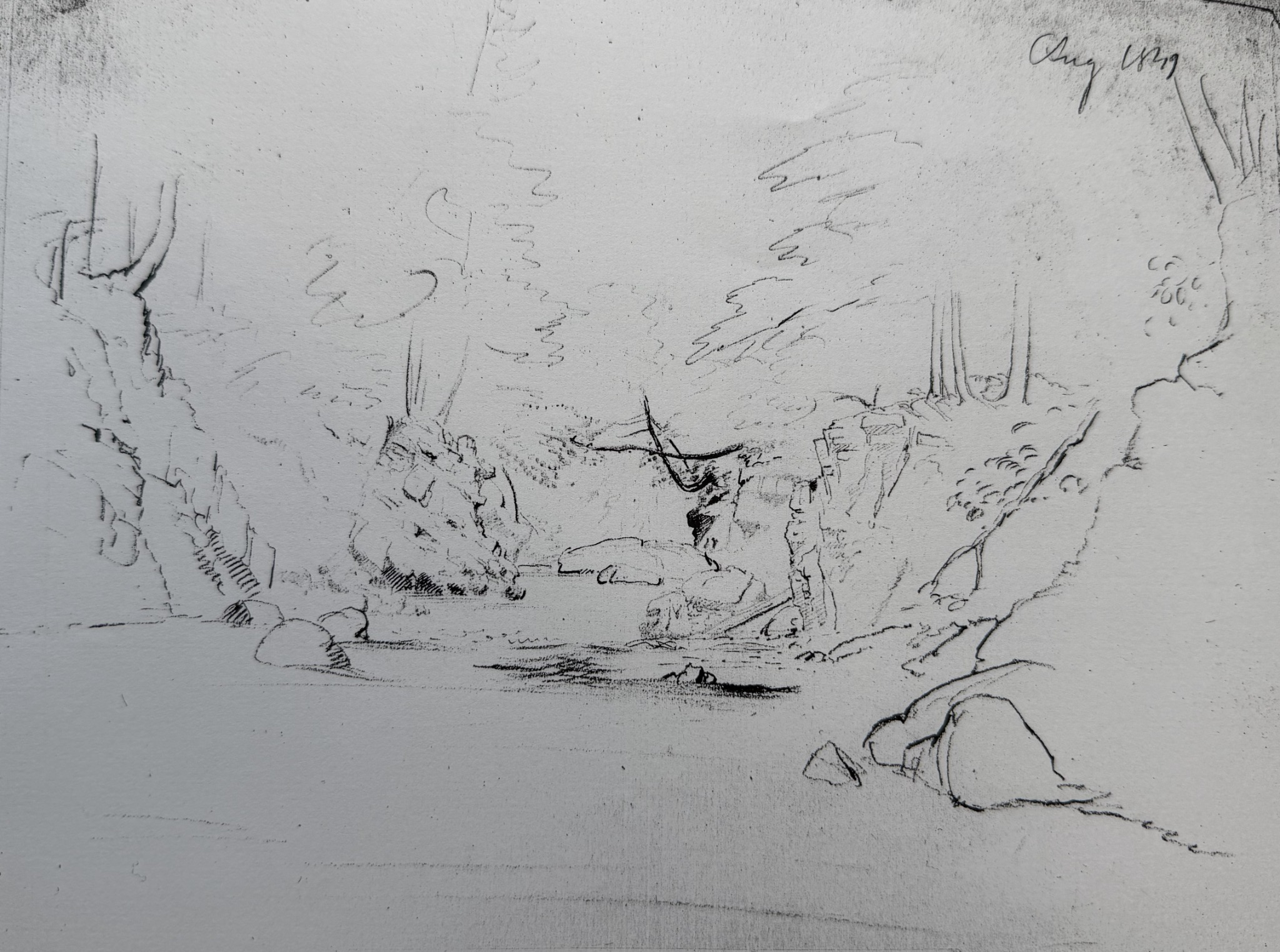
Brook (?) Near Cuttingsville. Vt. August 1849
(23 x 28.6 cms)
Sketch
inscribed in graphite on off-white paper. Olana, Cat. No.238.
OL.1980.1428.
Olana State Historic Site, Hudson, New York.
In this pencil sketch [1] there is a similar shaped and clear large Cross. Church has thickly and intentionally marked it darker than his other lines in the drawing. The Cross is made up of two intersecting saplings (or small trees) overhanging the main rock in the brook, above which it bestows a protective blessing. It is evident that Church has thickened the intersecting lines of the trees - the Cross - intentionally.
Church has seemingly positioned this Cross so prominently in the middle of the sketch, as an aide-mémoire - to be part of his visual diary which he consulted continually. [2]
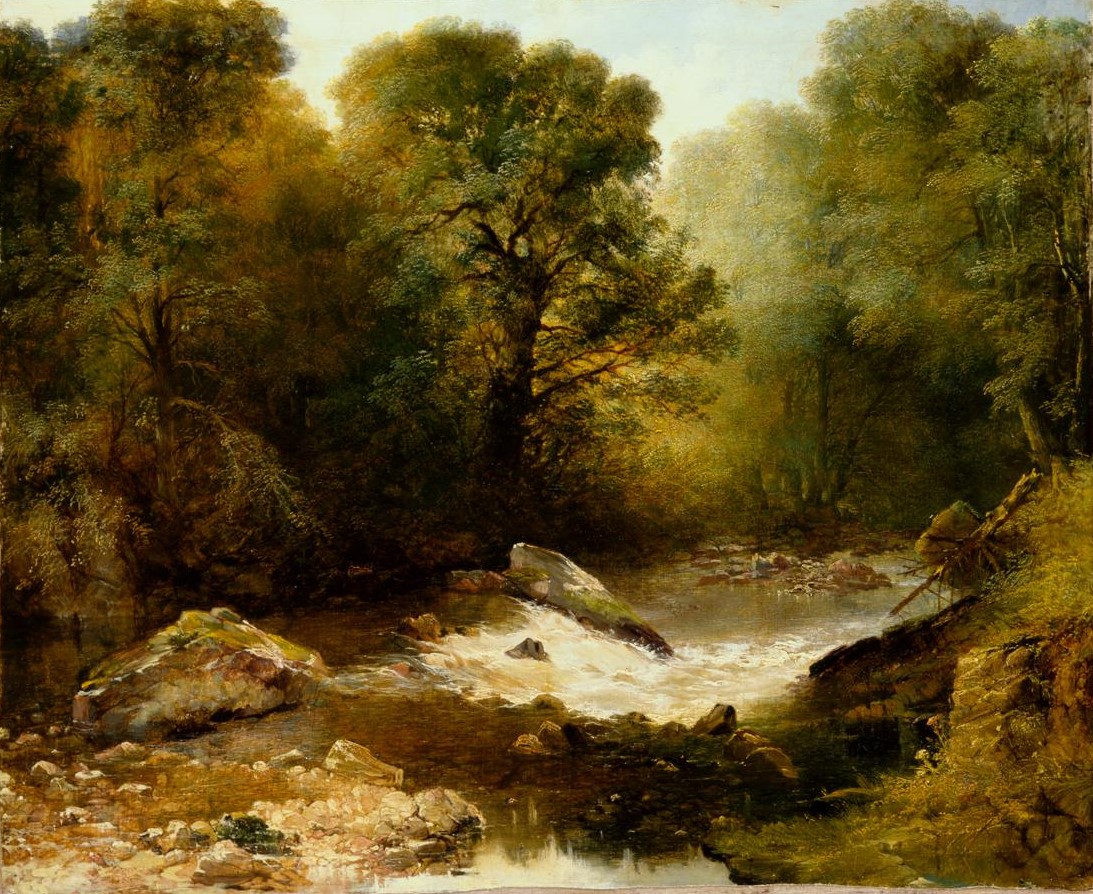
The fallen pointing tree is in the foreground - to the right - in all three pictures. Finally, in Rocky Forest Pool 1857 Church combined the log in the water (in Freeman Brook ?) with the pointing tree (in Freeman Brook ?) and turned it into the one, fallen pointing tree of the finished work. Three years later he used the same fallen pointing tree and the same small naturalistic Cross in Twilight in the Wilderness 1860 to impart the same Christian 'lesson.'
The small Cross of branches which is part of the fallen pointing tree in Rocky Forest Pool 1857 is in the same aspect of benediction above and over the water as the larger but similar one in, Freeman Brook (?) near Cuttingsville, Vt. The smaller Cross in Rocky Forest Pool 1857 has now found its spot closer to the Light on the Water.
Here, the trio or Trinity of trees -The Trinity - are on the stratified out-crop of rock to the right as well as on the left. Compare also Rocky Cascade (Cat no. 329 OL1977 0171 Olana State Historic Site) and its stratified out-crop of rock (to the right again) which figures in all four works in the same position - to the middle right in the sketches and to the middle right foreground in Rocky Forest Pool 1857.
The main rocks and boulders in the river are all similar in shape; compare those in the preparatory oil sketch In the New England Woods (now retitled Woodland Stream by Cooper Hewitt) 1856 (AAT attribution) with those of Rocky Forest Pool 1857. Compare also, the trio or Trinityof trees in Heart of the Andes 1859 and Twilight in the Wilderness 1860.
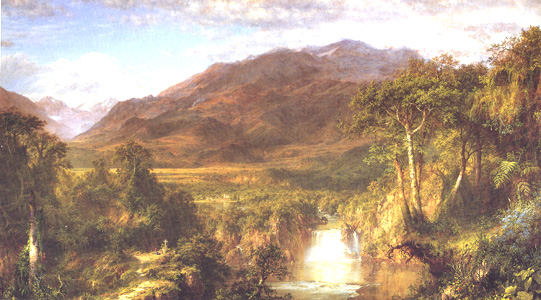
The preparatory sketches In the New England Woods (now retitled Woodland Stream by Cooper Hewitt) 1856 (AAT attribution) and Freeman Brook (?) Near Cuttingsville. Vt. August 1849 appear to be so closely related as to be the same location from slightly different angles. All three works depict the same scene.
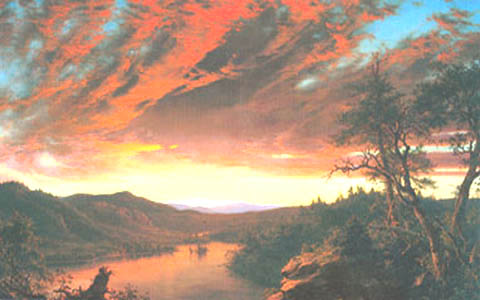
One year after his commemorative painting To the Memory of Cole 1848* with the small but quietly commanding presence of the Cross marking the grave of his mentor, Church began to think of more abstract ways of incorporating the Cross of Jesus into a natural landscape. [3]
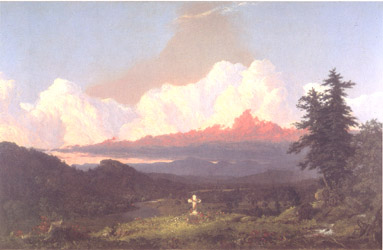
After
this pencil drawing it took another 6 years before he would
incorporate it discretely into the coded vernacular of his
paintings, starting with,
1.) The 'Golden Cross of Light' in, The
Andes of Ecuador 1855. Then came:
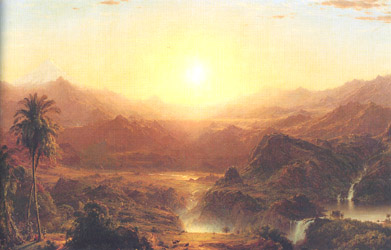
2.) The small Cross of branches in Rocky Forest Pool 1857.
3.) The Cross of Light from, The Evening Star 1858.
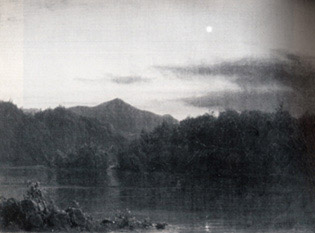
4.) the small Cross of bark in, Twilight in the Wilderness 1860 and
5.) the Cross of the mast from a ship wreck in The Icebergs 1861-62.
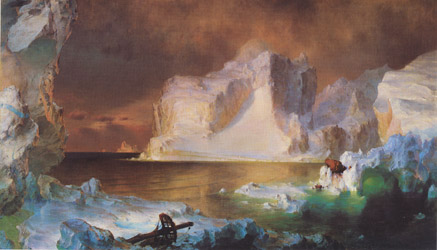
Church continued to show literal depictions of The Cross in The Andes of Ecuador 1855 and Cross in the Wilderness 1857, Heart of the Andes 1859 etc.
*
Sold for $4,732,000 by Sotheby's, New York in May 1999.
One year later, in May 2000, 'Mt
Newport on Mt Desert Island' (43.8 x 63.5cms) sold
for $4,186,000 by Christie's New York.
Additional context from the original page
As in the best of Church's work Rocky Forest Pool, transcends its literal depiction and Raises the Human Spirit To a Sublime Level of Transcendent Spirituality.
Notes and sources
Note 1
There are only 8 years between Freeman Brook (?) near Cuttingsville, Vt. August 1849 and Rocky Forest Pool 57.
Compare that, with Church's Niagara from the American Side 1867 which he painted 'relying solely on his own pencil drawing of October 1856,' - 11 years earlier. Tim Barringer, Assistant Professor in the History of Art, Yale University.
Note 2
Note 3
Again, 'Nothing is accidental; he has meditated his thought, breathed his inspiration, lived in the spirit of his subject, so that every stroke of his pencil is guided by the unerring instinct of faith in that which he beholds.' Russell's Magazine, 5th August 1859.
There are three representations of The Trinity within Rocky Forest Pool '57. A trilogy or Trinity of Trinities.
Its main lesson is - to find God you have to follow the Way of the Cross and the Light on the Water - which represents Christ - and which flows towards the Trinity of Trees representing The Holy Trinity in the luminous evanescent distance.
To activate the inter-active analysis of the Christian symbolism and find the Trinity of Trinities, please go to: Explore the Painting.
From the original Rocky Forest Pool study, © Oliver Thiebaud, 1985, 1995, 2002. Wording retained for review; interpretations and citations have not been independently verified.
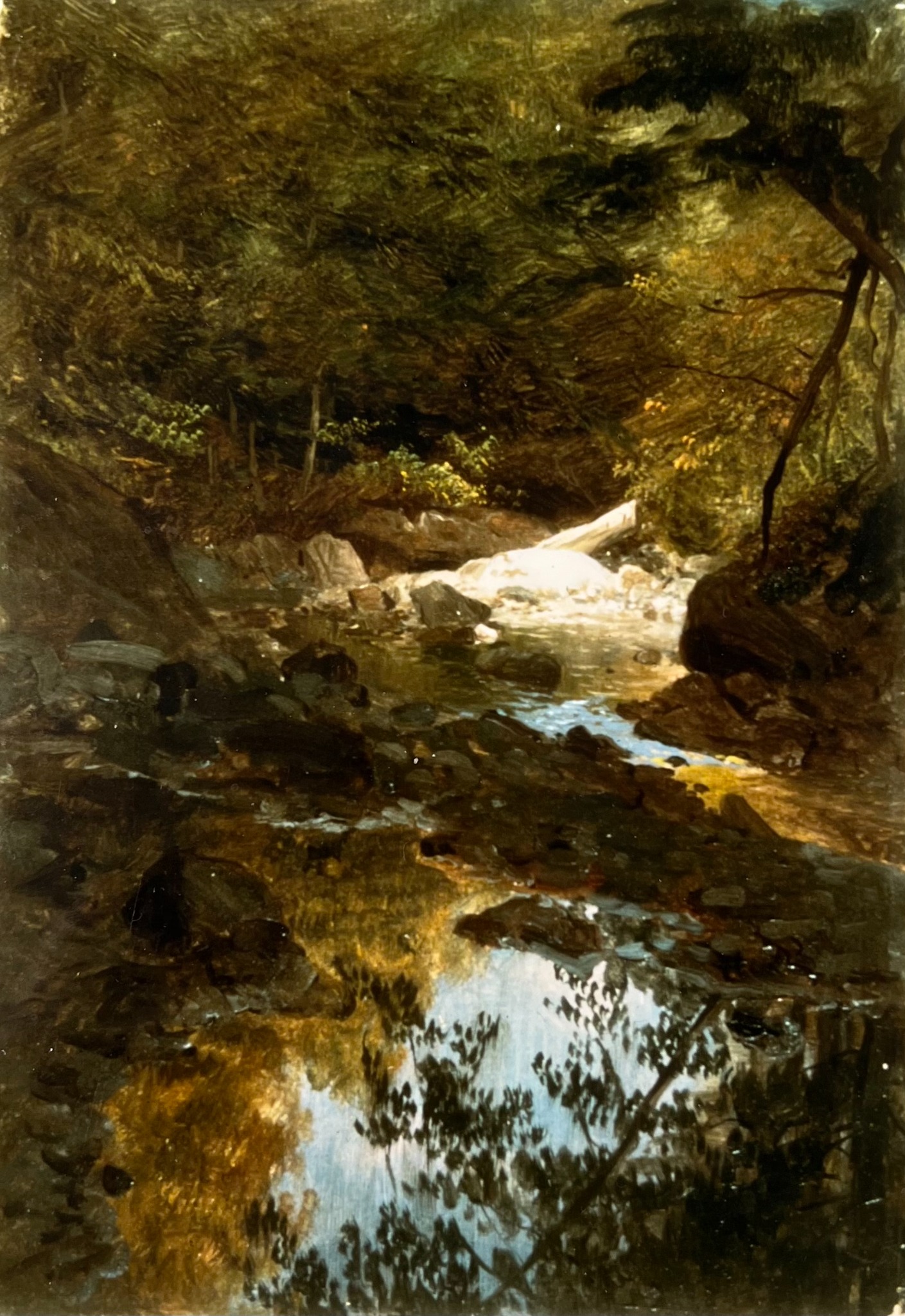
In the New England Woods (now retitled Woodland Stream by Cooper Hewitt) 1856 (AAT attribution)
Compare the oil sketch with the finished painting, including the trees, rock formations, reflected light and fallen branch.
In the New England Woods (now retitled Woodland Stream by Cooper Hewitt) 1856 (AAT attribution)
Dimensions: Museum Notes, H: OM173 x W: OM305
COOPER-HEWITT MUSEUM. REF: DP 1917- 4 - 664A
Humboldt believed that the use of 'coloured sketches taken
on the spot' were necessary. Church agreed and followed his
dictum in this oil sketch which - if studied carefully
reveals 15 similar features with Rocky
Forest Pool 1857.
In the New England Woods (now retitled Woodland Stream by Cooper Hewitt) 1856 (AAT attribution) also seems to be the actual location of Rocky Forest Pool 1857 (and if it is, the attributed date will need to be changed to 1856).
With all the other evidence - that would place it within a 40 x 10 mile region (running North/South) of the Green Mountain Forest in Vermont, Northern New England and starting from Cuttingsville and Clarendon in the middle.
The similar naturally fallen tree or branch of In the New England Woods (now retitled Woodland Stream by Cooper Hewitt) 1856 (AAT attribution) is reflected in the pool of water in the foreground. Instead of one end of the tree being in the water (as in the finished painting) it is pointing towards the Light on the Water as it also does in Rocky Forest Pool 1857.
Here, this 'crystal lake' or pool also reflects the sky and the Divine Light from on High. Where the Rock in the sketch is white with Light (using impasto) Rocky Forest Pool 1857 has the running water in the brook, white with Light (using impasto). The metaphor is changed in Rocky Forest Pool 1857 for the Way of Christ although the Rock remains partially lit from the same Divine Light source as the water - from 'on High' in both works.
In Rocky Forest Pool 1857 the fallen tree is now pointing as it does later in Twilight in the Wilderness 1860 with a similar Christian lesson. With In the New England Woods (now retitled Woodland Stream by Cooper Hewitt) 1856 (AAT attribution) the main tree supporting the pointing branch is described in the museum notes as 'a maple (?).' This pointing branch also points to a large Rock similar in size, shape and position to the Rock behind the pointing tree in Rocky Forest Pool 1857. This maple and its canopy of leaves are at the same angle and position and planted on a similar sized bank as the maple next to the fallen pointing tree in Rocky Forest Pool 1857
His colours in the sketch are the same as in his finished painting with the same shaft of blinding white Light illuminating the heart of the sketch - as in the main picture - thereby imparting its main 'lesson.' This shaft of Light is alo used by Church in his oil sketch A stream in the New England Mountains (Archive of American Art DP1917- 4 - 861). Like Durand's In the Woods 1855. which inspired him, Church starts with a vertical sketch of a scene visited.
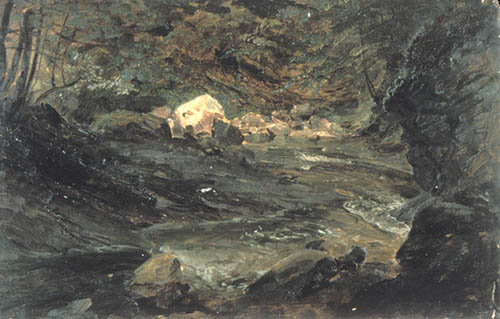
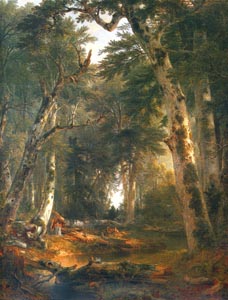
In the New England Woods (now retitled Woodland Stream by Cooper Hewitt) 1856 (AAT attribution) also shows the same brook flowing the same way towards the same hallowed Rock and a similar clump of trees to the Trinity of Trees in Rocky Forest Pool 1857
The viewer also hovers, suspended above the brook in both and similarly, it also leads you into the picture with the flow and direction of the water - towards the Divine (and away from yourself and human frailty?)
In this oil sketch, Church also introduces the same light-green pointïllistic feathering to paint the leaves which are catching the light particularly on the same (almost identical) sweeping branches to the middle-left in both paintings. This brushwork is technically like (and derived) from the trees in The Natural Bridge Virginia 1852
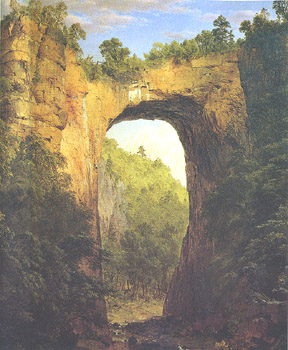
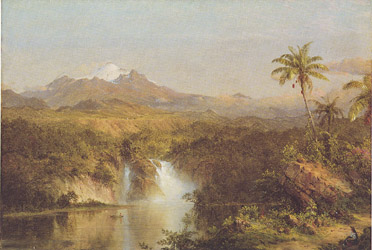
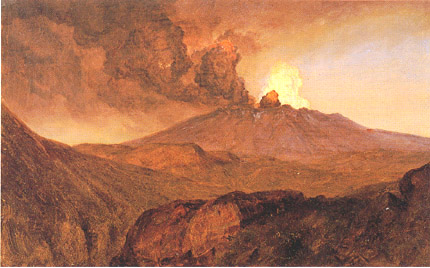
The background scumbling of trees is treated similarly in all of these oils including, View of Cotopaxi 1857. See similar scumbling work in, Distant View of Sangay Volcano, Ecuador 1857.
Additional context from the original page
As in the best of Church's work Rocky Forest Pool, transcends its literal depiction and Raises the Human Spirit To a Sublime Level of Transcendent Spirituality.
Notes and sources
Note 1
There are only 8 years between Freeman Brook (?) near Cuttingsville, Vt. August 1849 and Rocky Forest Pool 57.
Compare that, with Church's Niagara from the American Side 1867 which he painted 'relying solely on his own pencil drawing of October 1856,' - 11 years earlier. Tim Barringer, Assistant Professor in the History of Art, Yale University.
Note 2
Note 3
Again, 'Nothing is accidental; he has meditated his thought, breathed his inspiration, lived in the spirit of his subject, so that every stroke of his pencil is guided by the unerring instinct of faith in that which he beholds.' Russell's Magazine, 5th August 1859.
There are three representations of The Trinity within Rocky Forest Pool '57. A trilogy or Trinity of Trinities.
Its main lesson is - to find God you have to follow the Way of the Cross and the Light on the Water - which represents Christ - and which flows towards the Trinity of Trees representing The Holy Trinity in the luminous evanescent distance.
To activate the inter-active analysis of the Christian symbolism and find the Trinity of Trinities, please go to: Explore the Painting.
Note 4
From the original Rocky Forest Pool study, © Oliver Thiebaud, 1985, 1995, 2002. Wording retained for review; interpretations and citations have not been independently verified.