The essay
Technical ingenuity
Look at the handling of paint: translucent glazes, thickly applied highlights and the movement of water around the rocks.
Rocky Forest Pool 1857 demonstrates again, Church's superior and improving technical skills especially in his use of translucent glazes and impasto (thick paint) used here in his depiction of flowing water.
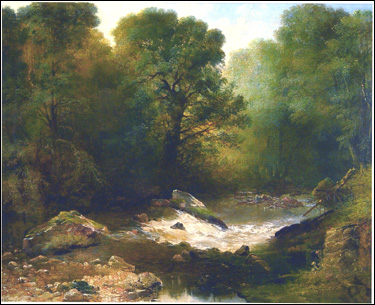
'Church - like Turner - skilfully manipulates his brushstroke so that the movement of the paint itself coincides with the movement and shapes of the water and rocks being depicted.' [3]
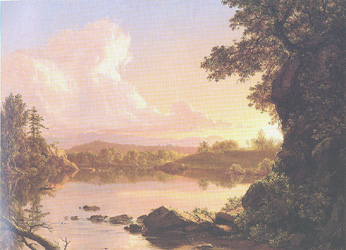
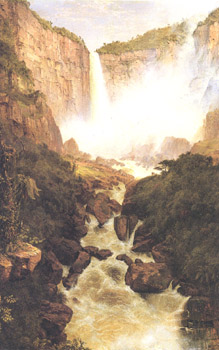
The rocks, the Light off the foaming water and the transparency of the clear limpid pools (Milton's,'crystal lake') [1] show considerable development from his earlier work such as Scene on the Catskill Creek 1847 and Tequandama Falls 1854.
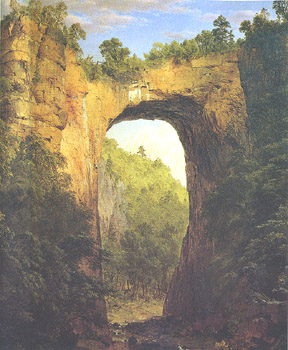
In painting The Natural Bridge Virginia 1852[2] he shows clearly his admiration for Ruskin and 'Ruskinian correctness' because for the first time he demonstrates complete mastery in painting and depicting, rock. The trees, woodland and sky of this (similar sized) picture are painted with the same techniques, colors and brushwork as those he used in Rocky Forest Pool 1857.
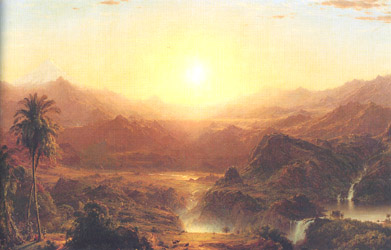
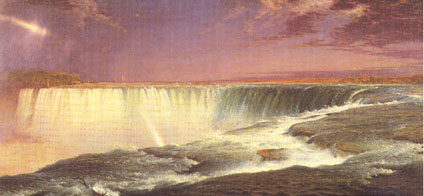
By 1855 with The Andes of Ecuador Church's first epic landscape 'he had perfected, unique effects of atmosphere and diffused sunlight' (using impasto for the central brook) but none of Church's paintings until now show that he completely understood or knew how to paint the flow of water convincingly. It was his greatest challenge which he finally conquered with, Rocky Forest Pool 1857 and, Niagara in 1857. Church's depiction of the flow of water and Light on the Water in Rocky Forest Pool 1857 is now perfected 'where the water washes the rock, the colour is lightish-yellowish brown, warm dry rock-grey and brownish but warm. We have never before seen it so perfectly represented' wrote, The Crayon about the water in Niagara in 1857. It is equally true of Rocky Forest Pool 1857. In 1852, The Natural Bridge Virginia 1852 was the first painting he showed publicly in Britain at the Royal Academy.
The
interest in Britain for Church's work grew to the point when
following the exhibition of The
Heart of the Andes 1859
The Art Journal proclaimed him,
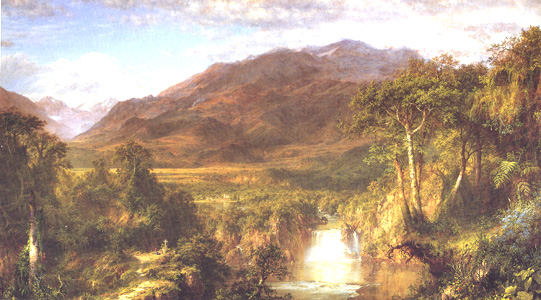
'The Heir Apparent of the great J.M.W. Turner.'
Additional context from the original page
The Heir apparent to the great J.M.W. Turner The Art Journal, 1860. In 1857, Church was 31 years old, at the height of his powers, eclipsing all others as, The Michaelangelo of Landscape Painting.
Notes and sources
Note 1
'Many mid-
nineteenth century Americans would have found a particular relevance
in any work of art that made reference to the Garden of Eden,
for the New World was, of course widely regarded by its proud
citizens as a second Eden.' Dr. F. Kelly p.p. 31 & 32: Frederic
Edwin Church and the National Landscape.
'In Paradise
Lost, book IV, Milton gives an extended description
of Eden, as seen through the eyes of Satan. Included are phrases
such as "her enclosure green," "sylvan scene," a "Heaven on Earth,"
all of which apply to Rocky Forest Pool '57.
Milton
also notes the numerous streams flowing through Eden, which gather
in a lake like a "crystal mirror." This 'mirror' is shown to better
effect in the preparatory oil sketch In the New England Woods (now retitled Woodland Stream by Cooper Hewitt) 1856 (AAT attribution),* Cooper Hewitt Museum. Ref: DP
1917-4-664A.
N.B. Go to,
the middle-right of Rocky Forest Pool 1857 and you
will notice that there is a 'region' of Light - reflected off
the light green trees in the luminous evanescent distance,
representing, God and, Paradise Regained.
Now look at the dark area to the middle-left (on the
left-hand side of, the ghostly Main Oak) to find - indescribable
darkness; representing, Satan and Paradise Lost.
'And the Light shineth in Darkness; and the Darkness comprehended
it not' The Gospel according to St John Chapter I, VerseV
(5). For a more detailed analysis go back to Explore the Painting
* To view go to: Introduction or Preparatory sketches
Note 2
'Church's interest in English art was shown in another way. In 1852, he sent one of his works The Natural Bridge, Virginia '52 to the annual summer exhibition of the Royal Academy in London.
The
Natural Bridge, Virginia '52 - in
size, color and technique- is most like Rocky Forest Pool '57.
'This faithfully detailed picture of one of the New World's most
celebrated wonders had amazed Church's friend Cyrus Field, who
had wagered that the artist would not be able to duplicate the
exact color of the rocks. When Church succeeded, Field agreed
to purchase the painting.' Dr. F. Kelly, p.46: A Passion
for Landscape: The Paintings of Frederic Edwin Church.
Church has painted the trees and the sky under the bridge in the same way, including the sweep of branches and the feathering of the leaves to the branches on the left and right foreground. It would be interesting to know how Rocky Forest Pool '57 came to England. Was it as a result of this exhibition?
By 1852 Church 'seems to have been receiving numerous commissions' that 'probably went directly from Church's studio to their owners.' Dr. F. Kelly, p. 148, footnote 32: Frederic Edwin Church and the National Lanscape.
Note 3
Ibid. p.112.
Re: Heart of the Andes 1859. The flow of water and
the background scumbling and color of trees in both are similar.
See also the foreground of Distant view of the Sangay Volcano,
Ecuador 1857 * for a similar treatment of the ghostly
Main Oak in Rocky Forest Pool '57.
* To view go to: References
From the original Rocky Forest Pool study, © Oliver Thiebaud, 1985, 1995, 2002. Wording retained for review; interpretations and citations have not been independently verified.