Research & records
Condition and conservation
The original record describes the painting’s materials, inscriptions, stretcher fragments and conservation work in 1973, 1974 and 2002.
Historical record: dates, ownership, locations, contact details and any sale statements below are reproduced from the original study. They have not been confirmed as current.
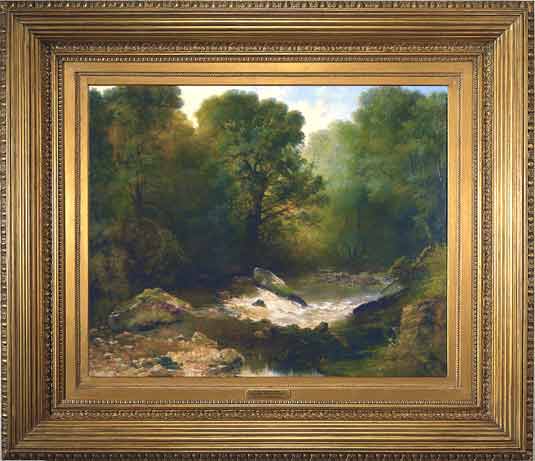
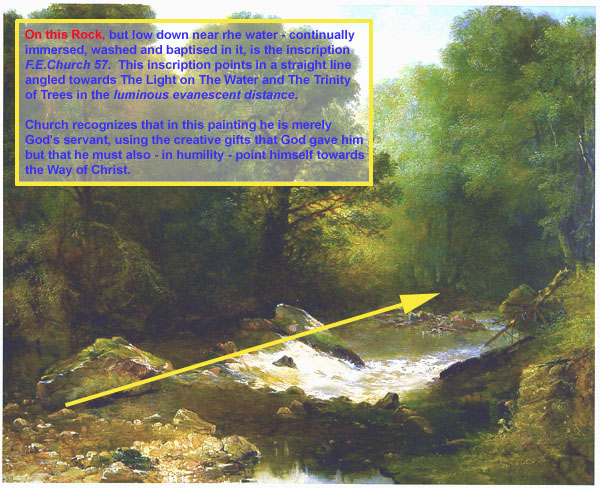
Inscribed and dated F.E. Church '57 [1] Main Boulder bottom left. [2]
1973 - The old varnish was discoloured but the paint surface was found in good condition. Painted on fine normal weave canvas with approx. 24 threads per cm and the old tacking edges trimmed to fit the new stretcher into its gold-leaf frame.
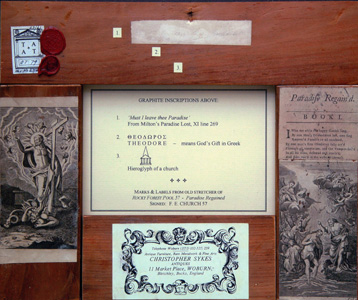
The
old stretcher
was slightly warped and replaced in 1974 when the painting
was relined but 5 sections have been retained (and 4 framed)
with the following marks and labels:
1.) Graphite inscriptions,  in Greek which means God's Gift (or Theodore)
A hieroglyph of a Church along with the owners seals and a
label reading, 'Must I leave thee, Paradise?'
*
2.) A page from Milton's Paradise Regained and
a print of Christ's Baptism.
3.) A print of The Risen Christ - from the
same (?) 18th century edition.
4.) An Art Dealer's Trade Label.
5.) A section with The Duke's seal has been glued
to the new (1974) stretcher on the back of the Painting, where
there is also, the Coat of Arms of the present owners.
1974. Relined with traditional hot glue adhesive. Old varnish and repaints along damaged edges were removed - see first footnote above. Some restoration along damaged edges. Re-varnished with Ketone N, cyclohexanone.
2002. Small thumb-sized area slightly damaged, center left in the trees, on 9th May. Damaged area photographed, restored and cleaned by a foremost restorer/conservator (a graduate of Hamilton Kerr, Cambridge University) who works in London for, The Tate, The V&A, and The National Gallery. Lightly cleaned and revarnished with Ketone N, cyclohexanone, a stable and easily removed varnish.
Sight
Size:
62.8 cms x 77.7 cms.
24¾ ins x 30 3/5 ins
Stetcher Size:
65.7 cms x 80.3 cms
25 7/8 ins x 32 3/8 ins
*
The
title Rocky
Forest Pool '57 has come - pre 1973 - from its
previous owner. From the inscriptions and prints glued to
the old stretcher and with other written evidence it's other
titles could perhaps be:
1) Paradise
Regained.
2)
Eden, rais'd in the waste wilderness, from the
first page of Book I of Milton's Paradise Regained,
which is glued to the stretcher.
3) The Gift
of God, is the meaning of the translation from the
Greek, THEODOROS - Theodore in English which is inscribed
in graphite on the old stretcher. This might also be a playful
reference to Theodore Winthrop who in turn called Church,
"Iglesias"- meaning church in Spanish, as there is also a
graphite doodle of a church underneath the Greek, Theodoros.
4) Must I
thus Leave Thee Paradise? from Milton's Paradise
Lost, XI line 269, which is also glued to the stretcher.
The inscription is a misquotation because of the omitted,
'thus.' Church used Milton's Paradise Lost (the
beginning of Book IX) as the title for Twilight,
"short arbiter 'twixt day and night 1850" once
known as Twilight.
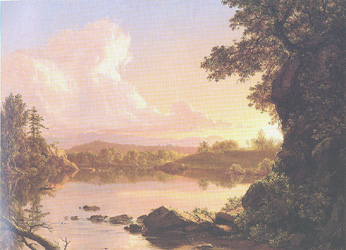
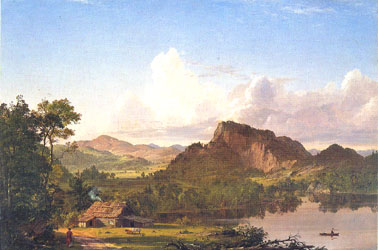
The titles of his paintings have often changed in the light
of more scholarly research, e.g., Scene
in the Catskills, was then known and sold as Home
by the Lake 1852 and now should be called Home
of the Pioneer, thanks to research by Dr. F. Kelly
& Dr. Gerald Carr. More research is needed into the title
Additional context from the original page
God's gift Paradise Regained
Notes and sources
Note 1
Church has inscribed F.E.Church 57 through the wet paint or glaze.
Before the painting was cleaned in 1973, the Inscription and the small Cross were more apparent in being highlighted.
The A.A.T., were informed by the restorer that they had been retouched with a dark brown line applied above the glaze and that these lines should be removed because it was 'unoriginal later work.'
Following this advice, and not 'seeing' or understanding the significance of the small Cross at the time, the A.A.T. regrettably advised the owners to allow this removal along with the re-touching around the edges of the canvas.
Now that we understand more about the significance of the small Cross and Church's use of glazes, we now believe that these, touch ups were in fact original paint work applied by Church over the glaze.
Although our latest museum restorer has not replaced these lines, we believe that at some time, these thin dark brown lines -with highlights-should be replaced.
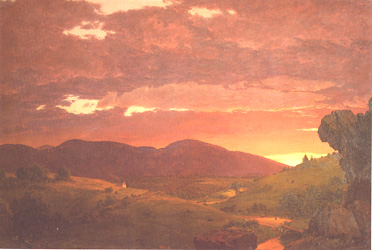
We now know that Church would often sign then re-sign and highlight- and sometimes double sign his work. In Lake Scene in Mount Desert Island 1851, Tim Barringer, Assistant Professor in the History of Art, Yale University, explains the technique, 'in painting the mountains, Church has scraped through the wet paint with the but-end of his brush, a technique familiar from his oil sketches, in order to articulate the contours of the rock surface'
Other examples include, Clouds over Olana 1872, Sunset across the Hudson Valley 1870, etc.
Note 2
From the original Rocky Forest Pool study, © Oliver Thiebaud, 1985, 1995, 2002. Wording retained for review; interpretations and citations have not been independently verified.