The essay
Inspiration
The study considers the influence of Turner, Ruskin, Thomas Cole and Alexander von Humboldt on Church’s treatment of nature, light and atmosphere.
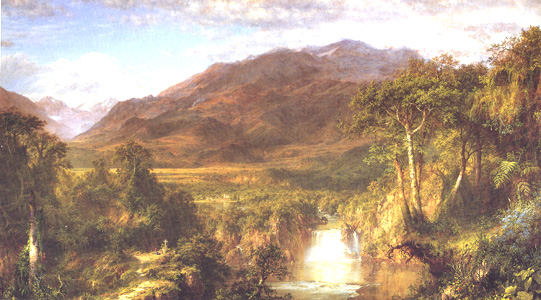
'It leads the eye into the distance, less by lineal or aerial perspective than by receding gradations of colour.' [1]
In Rocky
Forest Pool 1857
Church shows how much he has learnt, Technically and
Aesthetically from Turner & Ruskin -
'the law of evanescence or the way gradations of light and
atmosphere soften the appearance of distant objects' [2]
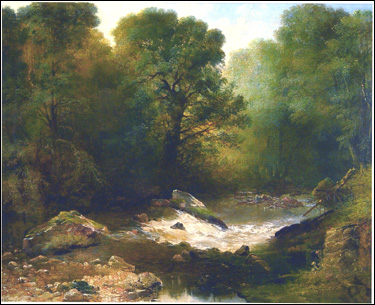
Church has learnt Philosophically and Spiritually from his mentors, Thomas Cole [3] and Alexander Von Humboldt [4] whose Cosmos confirmed many of Church's devout Christian beliefs in the existence of 'a divinely ordered structure of the world.'
Footnote Asterisk
* The Heart of the Andes 1859
Additional context from the original page
Church's study of Turner was probably of key importance in leading him to his consummate mastery of light and atmosphere in diffused and vaporous states. Dr. F. Kelly.
Notes and sources
Note 1
'Church, like
Turner, has mastered the secret of painting space.
He leads the eye into the distance less by lineal or aerial perspective
than by receding gradations of color.' This was the Ruskinian
comment by the New York Times supplement, National Academy
of Design of 20th April 1859 about the Heart of the
Andes 1859, but it is particularly relevant here.
Note also the similarity in the depiction of flowing water in
the center of Rocky Forest Pool '57 and that of
Heart of the Andes - to the bottom right.*
Note 2
Joseph
Mallord William Turner 1775-1851. The foremost British painter
of oils and watercolors of the first half of the 19th century.
A hugely influential Genius.
John
Ruskin, 1819-1900 was the foremost art critic writing in English
in the 19th Century and a talented practicing artist. He first
met Turner in 1840 and became his most earnest and articulate
admirer.
'Church's study of Turner was probably of key importance in leading
him to his consummate mastery of light and atmosphere in diffused
and vaporous states.' Dr. F. Kelly. p.112. Frederic Edwin
Church and the National Landscape.
Note 3
He believed however that Church had, 'the finest eye for drawing in the world' and although Church's work by the late forties and early fifties had surpassed technically the work of his mentor, Cole continued to have an enduring influence through out Church's life.
Note 4
Alexander Von Humboldt, 1769-1859 the world famous German Naturalist and Geographer who wrote Cosmos: Sketch of a Physical Description of the Universe. This was translated into English in the 1840's.
'Cosmos
was an attempt to synthesize existing scientific knowledge about
the world into a grand theoretical system that could explain
the underlying principles of the universe.' He 'was particularly
interested in landscapes as a means to acquaint people with
parts of the world they would never see.'
Dr. F. Kelly. P.47 A Passion for Landscape: The Paintings
of Frederic Edwin Church.
Church had sent The Heart of the Andes 1859* to Europe in the hope that his mentor would be able to view it but Humboldt died beforehand.
Humboldt's
theories, just as he had predicted, were 'scientifically' obsolete
by the time that, Charles Darwin published, The Origin
of Species in 1859, the very year that
Humboldt died. Church never owned a copy of this seminal work.
* To see the Painting below: Click on the blue.
From the original Rocky Forest Pool study, © Oliver Thiebaud, 1985, 1995, 2002. Wording retained for review; interpretations and citations have not been independently verified.