The essay
Introduction
An introduction to the study’s view of Rocky Forest Pool as a vision of wilderness, light and spiritual reflection.
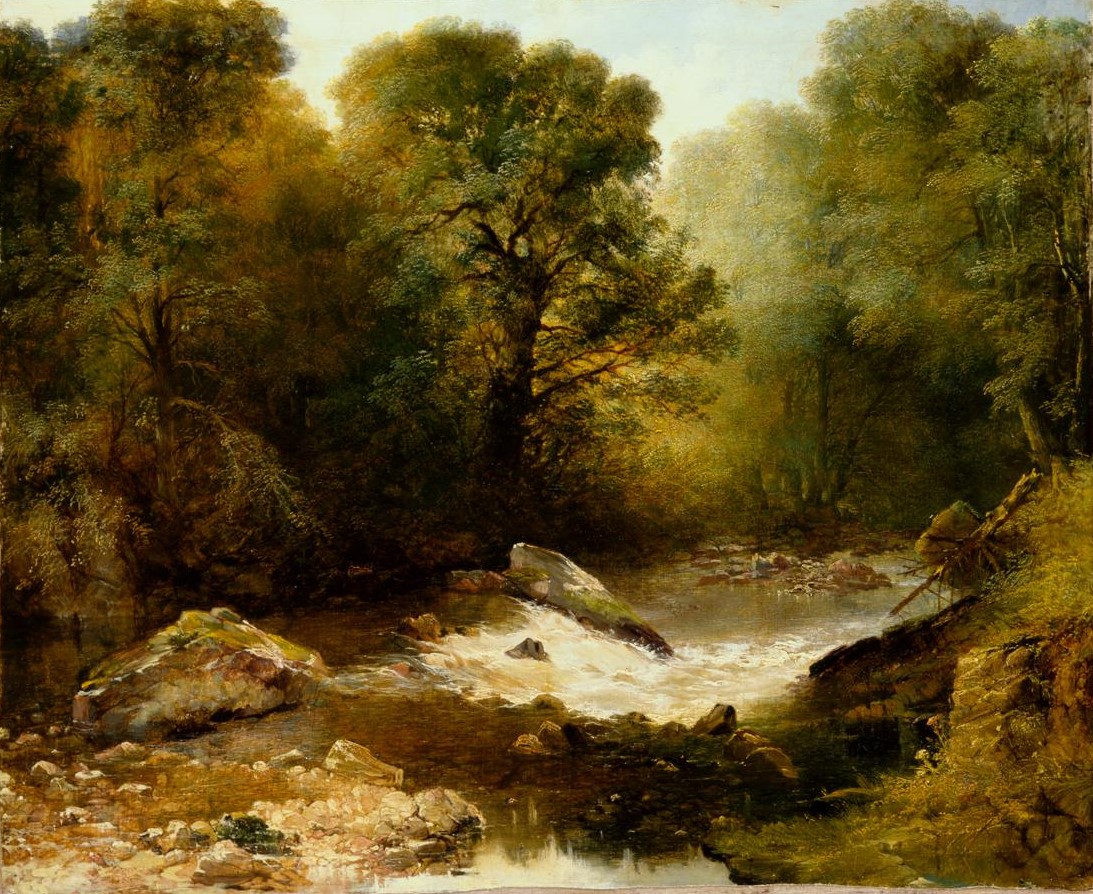
Rocky
Forest Pool 1857
Sight
Size: 62.8 cms x 77.7 cms. 24¾ ins x 303/5 ins
Rocky Forest Pool 1857 [1] exemplifies the pristine clarity of vision that characterizes Church's more mature draughtsmanship and reveals luminously the sublime spirituality of nature.
'After 1855, Church gradually moved towards an entirely new conception of the American Landscape in which wilderness became the dominant theme. Also during the 50's there was 'a new awareness of the ecological value of the wilderness within the sensitive balance of nature.' [2]
'Man has for too long forgotten that the Earth was given to him for usufruct alone, and not for consumption, still less for profligate waste.' Man in Nature: George P. Marsh. By the mid 50's, Church - aware of this - increasingly came to doubt his formerly unquestioning faith in 'the sanctity of National progress and the attainability of the Pastoral Ideal.' [3]
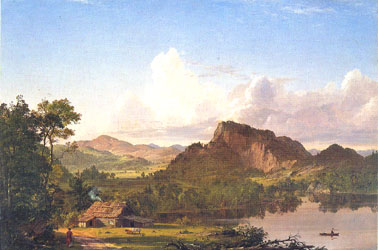
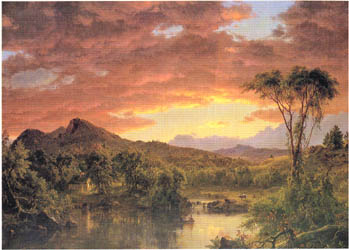
Rocky Forest Pool 1857 depicts 'the perfect and sublime wilderness' [4] where, 'no sawn tree stumps mar the foreground and there is no saw dust from the mill' and for the first time in his work of the 50's, there is no presence of Man nor of his detritus. The domestic, pastoral and rural promise of Home by the Lake 1852 * and A Country Home 1854 has given way to a luminous pantheistic vision, 'by which we may ascend to a great Temple.' The Crayon - commenting on Durand's In the Woods 1855.
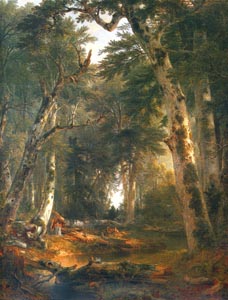
Like Asher B. Durand's In the Woods 1855, Rocky Forest Pool 1857 also 'invites the viewer into its sheltered recesses for a moment of meditation and contemplation.' [5] The scale is more human and inviting, the atmosphere more peaceful and soothing but the 'luminous evanescence' of Rocky Forest Pool 1857 transcends In the Woods 1855 in this and several other remarkable ways.
* Sold for, $8,250,000 by Sotheby's, New York on May 24th 1989
Additional context from the original page
Based on the preparatory sketches, In the New England Woods (now retitled Woodland Stream by Cooper Hewitt) 1856 (AAT attribution). Oil and pencil on card. Cooper- Hewitt, Design Museum. ref. DP 1917- 4 - 664A. And Also Freeman Brook (?) Near Cuttingsville. Vt. August 1849. Graphite on off-white paper. Olana, Cat. No. 238. OL. 1980. 1428. Olana State Historic Site, Hudson, New York..
Notes and sources
Note 1
'Church chose the titles of his major paintings carefully' writes Dr Franklin Kelly p. 120, chapter 6: Frederic Edwin Church and the National Landscape and he quotes The New York Daily Tribune of 9th June 1860 p.5 (appendix no.7): "Mr. Church evinces almost as much invention in bestowing names upon his pictures as he does in painting them."
The title Rocky Forest Pool '57 has come - pre 1973
- from its previous owner. From the inscriptions and prints glued
to the old stretcher
and with other written evidence its other titles could perhaps
be:
1) Paradise
Regained.
2)
Eden, rais'd in the waste wilderness, from the first
page of Book I of Milton's Paradise Regained, which
is glued to the stretcher.
3) The
Gift of God, which is the meaning of the translation from
the (misspelt) Greek, which should be -  - Theodore in English. This is inscribed in graphite on the old
stretcher and might also be a playful reference to Theodore Winthrop
who in turn called Church, "Iglesias"- meaning church in Spanish,
as there is also a graphite doodle of a church underneath the
Greek, Theodoros.
- Theodore in English. This is inscribed in graphite on the old
stretcher and might also be a playful reference to Theodore Winthrop
who in turn called Church, "Iglesias"- meaning church in Spanish,
as there is also a graphite doodle of a church underneath the
Greek, Theodoros.
4) Must
I thus Leave Thee Paradise? from Milton's Paradise
Lost, XI line 269, which is also glued to the stretcher.
The inscription is a misquotation because of the omitted, 'thus.'
Church used Milton's Paradise Lost (the beginning
of Book IX) as the title for Twilight, "short arbiter 'twixt
day and night 1850" once known as Twilight.
The titles of his paintings have often changed in the light of
more scholarly research, e.g., Scene in the Catskills,
was then known and sold as Home by the Lake 1852
and now should be called Home of the Pioneer, thanks
to research by Dr. F. Kelly & Dr. Gerald Carr. More research is
needed into the title.
Note 2
Note 3
Note 4
Note 5
Note 6
Born in Hartford,
Connecticut on the 4th May 1826. Died in New York on the 7th April
1900.
In the History
of Art, Church is recognised again as one of the World's greatest
Landscape Painters, alongside J.M.W. Turner.*
By the mid 1850's when he was fully mature as an artist he truly deserved his accolade as 'the Michaelangelo of Landscape Painting' and 'the Heir apparent to the great J.M.W. Turner.'
Photography, (Darwin?) and Impressionism have all contributed to the change in Art appreciation or fashion. North Americans' restless curiosity about the future along with, their ambition, energy and mobility have all conspired against looking backwards.
As America
goes into the 21st Century, with the confidence of a Great, Free,
Liberal and Democratic Nation, it is natural - in maturity - to
reflect on the past and in this case, on the homebred Genius of
their First Great Painter and on the Christian 'Lessons' that
he imparted through his Art.
Frederic
Edwin Church was, is, and will remain, the Eternal Genius.
* This is largely due to the fabulous Exhibitions of his work in the last 20 years which have come about largely thanks to the scholarship and enterprise of, David Huntingdon, Franklin Kelly and Gerald Carr. In 2002, Andrew Wilton and Tim Barringer gave us American Sublime at The Tate Gallery (Tate Britain).
From the original Rocky Forest Pool study, © Oliver Thiebaud, 1985, 1995, 2002. Wording retained for review; interpretations and citations have not been independently verified.